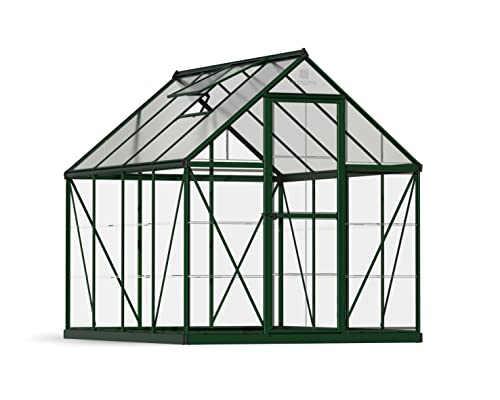
The Palram Canopia Hybrid is the model we rank first because it pairs a sensible footprint with unusually clear documentation. Palram, the maker, publishes the glazing type, the frame material, the door opening, and even wind and snow figures. Most competitors skip at least one of those. This profile goes through what the company says, who gets the most from a greenhouse this size, and where the design asks you to supply the missing pieces. For the full field, see our ranking of the best greenhouses of 2026.
We have not assembled or handled this greenhouse, and we do not take measurements of our own. Everything below comes from the maker’s published specifications and from general greenhouse guidance, and we say so where a number is not published.
What the Hybrid Is
The name describes the glazing. According to Canopia by Palram, the roof uses 4 mm twin-wall diffused polycarbonate, while the side walls use clear polycarbonate with over 90% light transmission and 100% UV protection. The idea is to scatter sunlight from above so leaves do not scorch in midsummer, while letting a lot of light in through the walls for stems and fruit. Plenty of kits use the same panel everywhere. This one splits the job.
The frame is powder-coated aluminum, which the maker describes as rust-resistant. Aluminum is the standard choice at this size because it does not rot or need repainting, and it keeps the weight low enough for two people to lift during assembly.
Dimensions and Layout
Palram lists the footprint at 8 ft 1 in long by 6 ft 1 in wide, with a height of 6 ft 10 in. That is roughly 49 sq ft of floor. Inside, you have room for a central aisle and a bench or shelving down each side, or for one long bench and a row of floor containers. A six-footer can stand upright near the center but will need to duck near the eaves.
The hinged door opening is 1 ft 10 in wide by 5 ft 4 in high, according to Palram. This is the detail buyers overlook. A door that narrow works for carrying trays, watering cans and small pots, but it will not take a wheelbarrow or a large decorative planter. If you plan to move heavy containers in and out through the season, measure your largest pot before you buy. The wider door on the Palram Canopia Balance 8x8 is the better fit for that job.
Ventilation and Gutter
The Hybrid has one manual roof vent and a built-in gutter, per Palram. The gutter lets you direct rain into a barrel, which is useful in dry regions and for gardeners who prefer rainwater for seedlings. The vent is opened and closed by hand, so you have to be home to react to a hot afternoon.
Extension guidance gives a useful yardstick here. The University of Georgia Cooperative Extension suggests that for natural ventilation, ridge vents should be about one fourth of the floor area, with side vents of about the same size, and it notes that side vents alone depend on wind and are usually inadequate. A 6x8 with a single roof vent will fall short of that rule on sunny days in much of the South and Southwest. Plan to add a solar-powered or wax-piston vent opener if the maker offers a compatible one, a small fan, or shade cloth, and leave the door open on warm days. In the Phoenix area or the Central Valley, a polycarbonate box this size can overheat quickly, and shade matters more than extra light.
Wind, Snow and Anchoring
Palram says the Hybrid withstands winds up to 56 mph and a snow load of 15 lb per sq ft. Both numbers are conditional on assembling the kit as instructed and anchoring it to a proper base. They are also ratings from the company, not a guarantee against a storm. A gust that tops 56 mph is not unusual in the Great Plains, along the Gulf Coast in hurricane season, or in Rocky Mountain wind corridors.
Snow is where the number needs context. A load of 15 lb per sq ft sounds large, but wet snow can weigh much more than powder, and ground snow loads in parts of the Upper Midwest, upstate New York and the mountain West exceed that figure. Your local building department can tell you the design ground snow load for your address. If yours is higher, treat the Hybrid as a spring-to-fall greenhouse, sweep the roof after storms, or consider a different structure.
The kit ships with no floor or base. Palram states that directly. Build a level foundation first. Options include a pressure-treated 4x4 or 4x6 perimeter frame set on compacted gravel, a ring of concrete pavers, or a poured slab. Then anchor the frame to the base with the hardware the instructions call for, or with ground anchors in soil. A greenhouse that is not anchored acts like a kite.
Permits, HOAs and Placement
In most of the country a 6x8 greenhouse counts as an accessory structure. Many towns waive permits under a size threshold, but the cutoff differs widely from town to town. Setbacks from property lines, maximum height and whether the structure may sit in a front yard can all apply even when a permit does not. HOAs are often stricter, and some require approval of color, location and screening. Ask before you buy, and keep the email.
For placement, the University of Georgia and other extension services advise choosing a spot with maximum light exposure, particularly in the morning. In practice that means an open southern or southeastern exposure, away from tall trees, with level ground that drains well. Keep the door within reach of a hose and, if you plan to run a heater or fan, within reach of an outdoor outlet on a GFCI circuit.
Winter Use
A small greenhouse moderates temperature; it does not generate warmth. USDA’s Plant Hardiness Zone Map is based on the average annual extreme minimum temperature, divided into 10°F zones with 5°F half zones, so your zone tells you how cold an average winter low gets. In zones 7 and warmer, an unheated 6x8 can carry cold-hardy greens and protect marginal perennials through most winters. In zones 5 and colder, it extends the season by a few weeks at each end unless you add heat.
If you do heat it, use a unit designed for greenhouse use, a thermostat, and a battery alarm for power loss. The Georgia extension publication recommends two smaller heaters over one big one for redundancy, and circulating air with a fan even when the heater is off. Never run a combustion heater without venting and a carbon monoxide detector.
Who Should Buy It
The Hybrid is a good match for:
- First-time greenhouse owners who want clear specs and a recognized brand.
- Gardeners in zones 6 to 9 who want to start tomatoes and peppers early and keep lettuce going well into late fall.
- Anyone who wants rain collection through the built-in gutter.
- Buyers in snowy but not extreme regions who value a published snow figure.
Who Should Look Elsewhere
- Gardeners who need wheelbarrow access: look at the Balance 8x8 with its wide double doors.
- Hot-climate growers who want two roof vents: the Mythos 6x8 has two manually adjustable vent windows and a galvanized steel base.
- Anyone who needs a lot of floor space for in-ground beds: a larger footprint will serve better.
- Buyers who want a ready-made floor: none is included here.
Warranty and Ownership
Palram lists a 5-Year Limited Warranty on the Hybrid. Read the terms before you order, because limited warranties usually exclude storm damage and misuse, and keep your order number. Plan on a few ongoing chores: rinse the panels once or twice a year to keep light levels high, check fasteners after the first season, lubricate hinges, and clear leaves from the gutter.
Bottom Line
The Hybrid earns its place by being transparent. You can see what the roof is made of, what the walls are made of, how large the door is, and what Palram says about wind and snow. What you do not get is a floor, a second vent or a wide door. If you are comfortable building a simple base and adding airflow, it is a strong first greenhouse. Use the button below to see the current price on Amazon.
See price on Amazon
Sources