Best Greenhouse for Winter: Cold-Climate Buying Guide
Picking an outdoor greenhouse for cold winters: twin-wall vs single-wall vs PE, snow load, anchoring, safe heating and venting, plus the kits that fit.
At a glance
For cold winters, the Palram Canopia Hybrid 6x8 is the kit that publishes both wind and snow ratings, with a twin-wall roof. The Palram Canopia Mythos 6x8 uses twin-wall panels all around, and the Palram Canopia Balance 8x8 adds room to work. Soft-sided tunnels and cabinets only stretch the season.
People who search for a greenhouse for cold winters are usually asking two different questions. Will the structure survive snow and wind? And will anything inside stay alive when the thermometer drops? A greenhouse answers the first question mostly through its roof, its frame and its anchoring. It answers the second through insulation, heat and how well you manage sunny days. This guide covers both, then points to the kits from our list that make sense for northern gardeners and explains why a few others do not.
We have not assembled or handled any of these kits. We compared what the manufacturers publish and what university extension services say, and we flag every spot where a number is missing. Our full ranking is in the best greenhouses of 2026.
Start With Your Zone and Your Goal
Look up your location on the USDA Plant Hardiness Zone Map. It uses 10-degree Fahrenheit zones, with 5-degree half zones, based on the average annual extreme minimum winter temperature. That number tells you how cold the worst nights typically get, which is the number that decides what a greenhouse can protect.
Then decide what winter job you want the greenhouse to do. Three goals need three very different structures:
- Season extension. Hardy greens, overwintered herbs and early seedlings. An unheated greenhouse works for this in many climates.
- Frost protection. Keeping potted citrus, rosemary or tender perennials above freezing. This usually needs a little heat and an insulated structure.
- Winter growing. Warm-season crops in January. This needs real heat, supplemental light in northern latitudes and a structure designed for the load.
Be honest about which goal is yours. The structures below fit the first two goals well and the third only with a budget for heating.
Twin-Wall, Single-Wall or PE Film
The covering is the biggest winter variable. University of Alaska Fairbanks Extension says double-sheet polycarbonate loses some light but reduces heat loss more than single sheets, and lasts longer. The same publication says a double layer of plastic film reduces heat loss by 35 percent while cutting light by about 10 percent. Translated into buying advice:
- Twin-wall polycarbonate traps a layer of air between two skins. It holds heat better and diffuses light, which makes it the practical choice for cold climates.
- Single-wall polycarbonate is clear and bright, and it is fine for spring and fall. It loses heat faster, so in deep cold it behaves more like a windbreak than an insulator.
- PE film is the cheapest cover and gives the biggest growing area for the money, but it is a seasonal cover that needs replacing and does not shed heavy snow the way a rigid roof does.
Before you assume a kit is twin-wall, read the maker’s page. Palram’s Hybrid describes a 4 mm twin-wall diffused roof with clear walls, and the Mythos lists twin-wall panels all around. For the Snap & Grow we did not find a twin-wall claim in the material we read, so do not assume it is twin-wall unless the listing says so.
Snow Load: Read the Fine Print
Snow is where the marketing gets thin. Among the ten greenhouses on our list, the Palram Hybrid is the only model that publishes both a wind and a snow number. According to Canopia by Palram, the Hybrid 6x8 withstands winds up to 56 mph and 15 lb per sq ft of snow. VEVOR rates the roof of its 8x10 for up to 5.12 lb per sq ft, and says it withstands Beaufort 6 to 7 winds when properly installed and reinforced. For the remaining kits we found no rating we could verify, and we are not going to guess.
Wet snow is heavy, and a few inches of wet snow can approach or exceed the rating of a light kit. A few habits matter more than any spec:
- Clear the roof early. Use a soft broom or a foam roof rake and work from the ground or from inside, pushing snow off in small passes. Do not chip ice with a shovel or climb on polycarbonate.
- Watch drifts. Snow sliding off a nearby roof or building can land on a greenhouse in one heavy slab.
- Choose a pitched roof over a flat one. The University of Alaska Fairbanks publication notes that steep, sloping sides help snow shed and that light hoop-style frames are the most vulnerable to heavy snow.
Anchor It Like You Expect a Storm
Winter wind is rarely a problem on a calm day and a serious problem on one bad night. Anchor the frame through its base to a level foundation, such as a pressure-treated timber frame on gravel or a concrete slab, rather than relying on the weight of the kit. North Carolina State Extension, writing about a homemade hobby house, describes corner posts that anchor the structure against high winds and a level foundation with the top at or above ground level to keep rain out. The same logic applies to a kit: a level, anchored base keeps doors working and panels sealed.
Most of these kits ship without a floor or base. Palram says the Hybrid has no floor or base included, so budget for a foundation. Also ask your city or county about permits. University of Georgia Extension notes that building permits are usually required for a greenhouse, and thresholds for small structures vary.
Heating Safely
You do not need much heat to protect hardy plants, but you do need to choose heat carefully. A small greenhouse has a large surface area for its volume, so it loses heat quickly, and a heater sized for the coldest night will cycle on and off on milder ones, according to University of New Hampshire Extension.
- Electric first. North Carolina State Extension suggests heat lamps or a small electric heater for very cold nights, with electrical devices on a GFCI outlet or breaker. Use a heater with a listing mark from a recognized lab such as UL or ETL, and keep cords, thermostats and plug connections out of wet areas.
- Be wary of combustion heaters. Ohio State University Extension says gas and kerosene heaters should not be used in airtight buildings, that they carry a carbon monoxide risk and that gas models should have an oxygen depletion sensor. It also advises keeping heaters at least 3 feet from other objects. University of Alaska Fairbanks Extension adds that unvented gas heaters can release ethylene that harms plants such as tomatoes, and that combustion gases should be vented outside. In a tightly sealed polycarbonate kit, we would avoid unvented combustion heaters entirely, and never run one without fresh-air ventilation.
- Add a thermometer. A min/max thermometer shows you how cold the greenhouse actually got overnight, which is the single most useful number you can collect.
- Insulate the plants too. Row covers pulled over crops at night, and pots on boards instead of cold soil, add degrees for almost nothing.
Venting on Sunny Winter Days
Cold air outside does not mean a cold greenhouse at noon. University of Georgia Extension warns that a greenhouse can overheat even in cold weather, and it describes automatic vent systems as the best option compared with hand-operated vents. University of New Hampshire Extension recommends an automatic vent opener for spring and fall. A wax-cylinder opener costs little and does not need electricity. Without one, you will be opening and closing the door by hand, and the one sunny afternoon you forget is the afternoon that scorches the seedlings. Also remember to close the vents before sunset.
Which Kits Fit a Cold Winter
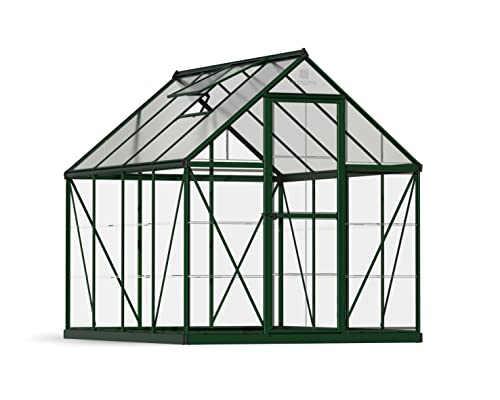
Palram Canopia Hybrid 6x8: The Published-Ratings Pick
A twin-wall roof with clear walls, and the only kit we found that publishes both a wind and a snow rating. A fit for northern gardeners who want a walk-in starter.
The Hybrid is the one we would start with. According to Canopia by Palram, the roof is 4 mm twin-wall diffused polycarbonate, the walls are clear polycarbonate with over 90% light transmission, the aluminum frame is powder-coated, and the kit withstands winds up to 56 mph and 15 lb per sq ft of snow. It has a manual roof vent, a built-in gutter and a 5-year limited warranty. The footprint is about 8 ft by 6 ft. The trade-offs are manual vents and no included base. Read our Hybrid 6x8 profile for the details.
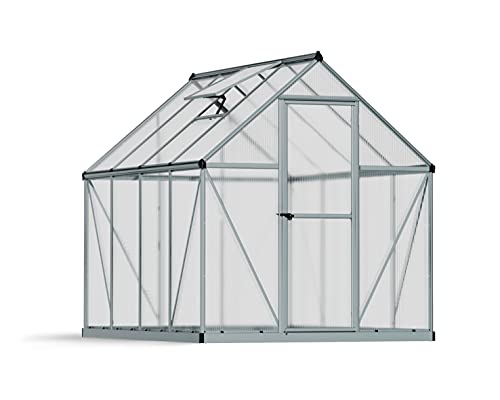
Palram Canopia Mythos 6x8: Twin-Wall All Around
Twin-wall panels on every side and a galvanized steel base, with two roof vents. A fit for gardeners who value insulation over maximum light.
The Mythos has the same footprint as the Hybrid but puts twin-wall panels on the walls as well as the roof, which should hold heat better on windy nights. Palram lists a galvanized steel perimeter base and two manually adjustable roof vents. We did not find a snow or wind rating for it, so ask yourself whether your winters are dry and cold or heavy and wet. If heavy snow is common, we would choose the Hybrid for its published figures. Our Mythos 6x8 profile has the rest.
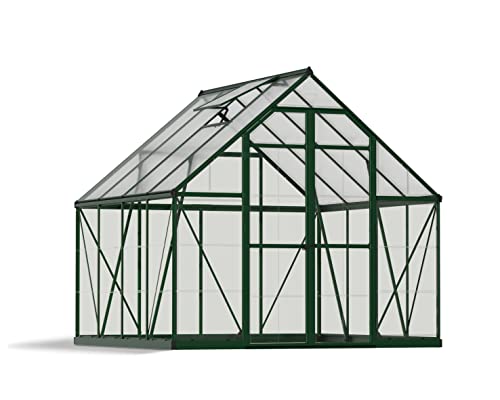
Palram Canopia Balance 8x8: Room to Work
A larger hybrid-glazed kit with a twin-wall roof, wide double doors and a taller ridge. A fit for gardeners who plan to spend winter afternoons inside.
According to Canopia by Palram, the Balance combines twin-wall roof panels with clear wall panels, a rust-resistant aluminum frame with extra support beams, wide double doors with a low threshold and a height of about 7 ft 6 in. The footprint is about 8 ft by 8 ft. More volume means slower temperature swings, though also more to heat. We could not find a wind or snow rating, so the same caution applies. See our Balance 8x8 profile.
Palram Canopia Snap & Grow 6x12: Long Benches, Milder Winters
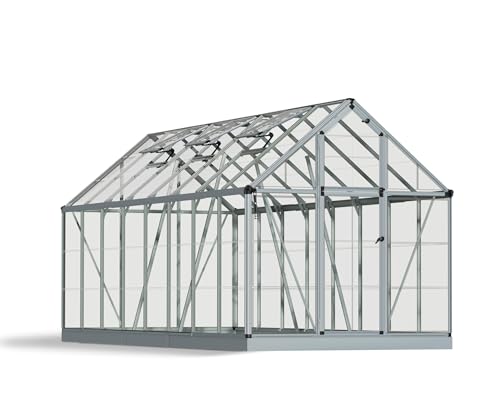
A long, narrow kit with clear panels, a Dutch door and an aluminum frame. A fit for hardy greens and overwintering in moderate winters.
The Snap & Grow gives you the most bench length in a narrow yard, and its clear panels let in over 90% of light, according to Palram. Its Dutch door is handy for venting. The cautions are that we found no twin-wall claim and no snow or wind figure, so we would place it in the moderate-winter group. In a hard-freeze zone, plan on extra insulation or on using it mainly from fall through early spring. Our Snap & Grow profile explains the limits.
Season Extenders, Not Winter Greenhouses
Two budget picks come up in winter searches, and we think you should know what they can and cannot do.
The Quictent 20x10 tunnel is a two-layer PE cover on a steel frame, anchored with U-type stakes. It offers a huge growing area, but a soft cover does not insulate well and does not shed heavy wet snow like a rigid roof. Treat it as a spring-to-fall structure in cold zones, or plan to clear snow often or remove the cover.
The Outsunny cold frame cabinet is a small polycarbonate cabinet with shelves and a lift-up top. It is useful for hardening off seedlings and protecting a few pots from a light frost. It is not a walk-in and it is not a winter greenhouse.
We also left out the VEVOR 8x10 from our winter picks, not because it is unusable but because its 5.12 lb per sq ft roof rating is the maker’s claim and is well below the snow figure Palram publishes for the Hybrid. If you want to read about it anyway, see the VEVOR 8x10 profile.
A Short Winter Checklist
- Look up your zone and write down your coldest typical night.
- Pick a twin-wall roof if winters are hard.
- Look for a published snow rating, and treat missing ratings as unknown.
- Build a level base and anchor the frame through it.
- Check permits and HOA rules before you order.
- Plan electric heat on a GFCI outlet, and skip unvented combustion heaters in a sealed kit.
- Buy an automatic vent opener and a min/max thermometer.
- Keep a soft broom handy for snow.
Sources
- USDA Plant Hardiness Zone Map (USDA Agricultural Research Service)
- Greenhouses for Home Gardeners in Alaska (University of Alaska Fairbanks Cooperative Extension)
- Non-Vented Heaters for Trainers and Supervisors (Ohio State University Extension)
- A Small Backyard Greenhouse for the Home Gardener (N.C. Cooperative Extension)
- Very Small Greenhouses for Back Yards (University of New Hampshire Extension)
- Hobby Greenhouses, Bulletin 910 (University of Georgia Cooperative Extension)
Frequently asked questions
Can a polycarbonate greenhouse stay outside all winter in a cold climate?
Yes, as a structure, if the kit is anchored and the roof can handle your snow. Whether plants survive is a separate question. An unheated greenhouse cools to near outdoor temperature within an hour or two after sunset, according to University of New Hampshire Extension, so it protects hardy crops rather than keeping tender ones warm.
How much snow can these greenhouses hold?
Only Palram publishes both a wind and a snow figure among the kits we looked at. According to Canopia by Palram, the Hybrid 6x8 withstands 15 lb per sq ft of snow and winds up to 56 mph. VEVOR rates the roof of its 8x10 for up to 5.12 lb per sq ft. For the other models we found no rating we could verify, so we do not quote one.
Is it safe to heat a small greenhouse with a propane or kerosene heater?
Be careful. Ohio State University Extension says gas and kerosene heaters should not be used in airtight buildings, that gas heaters should have an oxygen depletion sensor, and that these heaters carry a carbon monoxide risk. Many gardeners avoid combustion heaters in a small kit and use a small electric heater on a GFCI-protected outlet instead.
Do I need to open the vents in winter?
On sunny days, yes. A small greenhouse can overheat even in cold weather, and University of Georgia Extension notes that ventilation and cooling are essential. Opening the door is often enough for a small kit, and an automatic vent opener removes the guesswork.
Is twin-wall better than single-wall polycarbonate for winter?
For heat retention, generally yes. University of Alaska Fairbanks Extension says double-sheet polycarbonate loses some light but reduces heat loss more than single sheets and lasts longer. The trade-off is a bit less light, which matters most in the darkest weeks.
Which USDA zone do I need to worry about?
Look up your own location on the USDA Plant Hardiness Zone Map, which uses 10-degree Fahrenheit zones based on the average annual extreme minimum winter temperature. A greenhouse that comfortably extends the season in a milder zone may only give modest protection in a colder one.